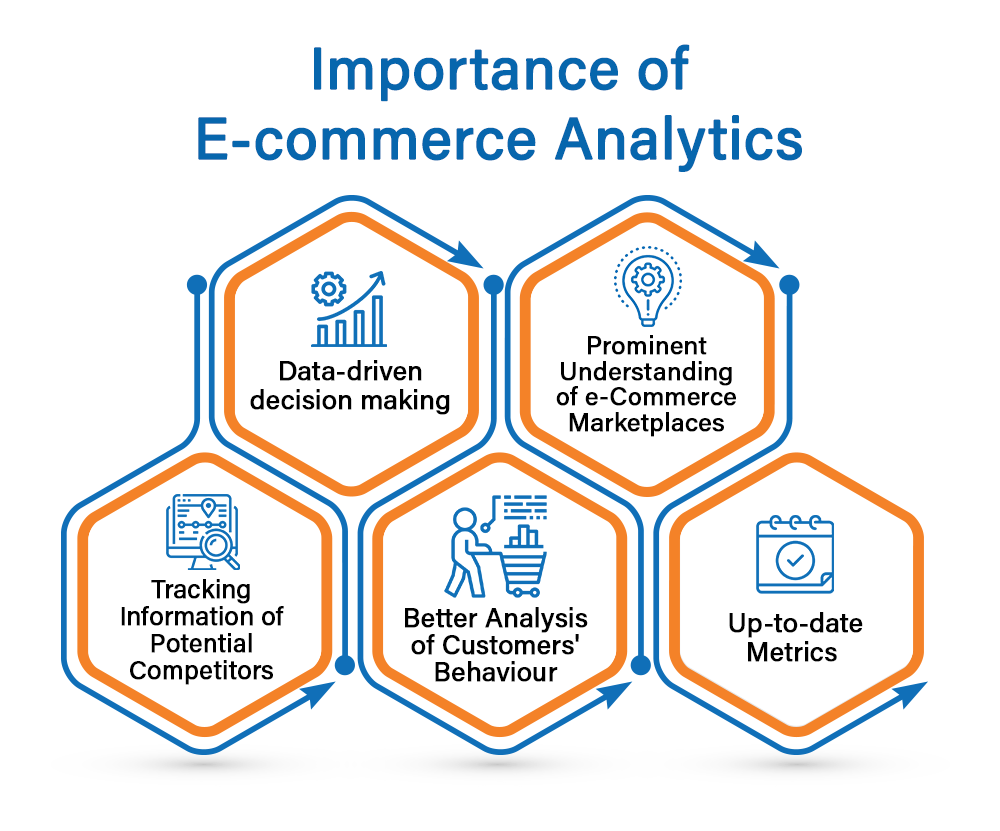
Introduction: Why Data Is Becoming the New Competitive Advantage in eCommerce
The eCommerce industry is growing rapidly, but so is the competition. Today, businesses are not only competing on product quality or pricing; they are competing on how effectively they understand and serve their customers. This is where data analytics in eCommerce has become a powerful tool for making smarter, faster, and more profitable business decisions.
Every customer interaction creates valuable information — from product searches and website visits to purchase history, reviews, and abandoned carts. When businesses analyze this information correctly, they can identify buying patterns, improve customer experiences, optimize marketing campaigns, and increase revenue.
Modern brands no longer rely only on assumptions or traditional methods. They use eCommerce analytics, customer behavior data, and business intelligence solutions to understand what customers want and predict what they may need next.
Whether it is deciding which products to promote, improving website performance, managing inventory, or creating personalized offers, data-driven decision making helps online businesses reduce uncertainty and achieve sustainable growth.
Quick Facts: Data Analytics in eCommerce
- Data analytics in eCommerce helps businesses understand customer behavior, sales trends, and market opportunities.
- Businesses using customer data analytics can create more personalized shopping experiences.
- Predictive analytics for eCommerce allows brands to forecast demand and optimize inventory.
- Real-time analytics helps businesses respond quickly to changing customer preferences.
- Effective use of eCommerce business intelligence improves operational efficiency and profitability.
| Area Improved Through Analytics | Business Impact |
|---|---|
| Customer Insights | Better understanding of customer needs and preferences |
| Marketing Performance | Higher campaign effectiveness and improved ROI |
| Inventory Management | Reduced stock issues and improved demand forecasting |
| Customer Experience | Personalized recommendations and smoother shopping journeys |
| Sales Decisions | More accurate planning and revenue growth |
Understanding the Role of Data Analytics in eCommerce Growth
Data analytics is the process of collecting, organizing, and analyzing large amounts of information to discover meaningful insights. In an online business environment, this data comes from multiple sources, including websites, mobile applications, customer reviews, social media platforms, and sales transactions.
For an eCommerce business, analytics transforms raw information into practical strategies. Instead of guessing why sales are increasing or declining, companies can identify the exact factors influencing customer decisions.
For example, an online fashion store may notice through analytics that customers frequently browse winter jackets but leave before purchasing. This insight can help the company investigate pricing, product descriptions, delivery options, or customer reviews to improve conversions.
Businesses that adopt data-driven eCommerce strategies can make decisions based on real customer behavior rather than assumptions.
1. Better Understanding of Customer Behavior
One of the biggest advantages of eCommerce data analytics is understanding how customers interact with a brand.
Analytics tools track important customer activities such as:
- Products viewed
- Search patterns
- Time spent on pages
- Shopping cart activity
- Purchase history
- Repeat buying behavior
This information helps businesses create detailed customer behavior analysis reports.
For instance, if analytics shows that customers often purchase smartphones along with protective cases, an online store can create bundle offers to increase average order value.
Understanding customer preferences also allows businesses to improve:
- Product recommendations
- Website navigation
- Marketing messages
- Customer retention strategies
When customers receive relevant experiences, they are more likely to return and make future purchases.
2. Personalized Shopping Experiences Increase Customer Engagement
Customers today expect brands to understand their interests. Generic marketing messages are becoming less effective because shoppers prefer personalized experiences.
Using personalization in eCommerce through data analytics, businesses can recommend products based on previous interactions and purchasing patterns.
Examples include:
- Showing similar products based on browsing history
- Sending personalized email recommendations
- Offering discounts on frequently viewed items
- Displaying location-based offers
Large eCommerce platforms use AI-powered analytics and machine learning algorithms to analyze millions of customer interactions and deliver personalized suggestions.
Small and medium businesses can also use similar approaches by implementing effective eCommerce technology solutions and analytics platforms.
3. Smarter Inventory and Demand Forecasting
Inventory management is one of the biggest challenges in online retail. Overstocking increases storage costs, while understocking can result in lost sales.
With predictive analytics in eCommerce, businesses can forecast future demand by analyzing:
- Previous sales records
- Seasonal trends
- Customer purchasing patterns
- Market changes
- Product performance
For example, an online electronics store can analyze previous festival sales data to predict which products will have higher demand during upcoming seasons.
This enables businesses to maintain the right inventory levels and improve supply chain efficiency.
Companies looking to build scalable platforms often invest in custom software development solutions that integrate analytics capabilities into their eCommerce systems.
4. Improved Marketing Decisions and Higher ROI
Marketing without analytics can lead to wasted budgets. Businesses need to know which campaigns generate results and which require improvement.
Marketing analytics for eCommerce provides insights into:
- Customer acquisition costs
- Conversion rates
- Campaign performance
- Customer lifetime value
- Return on advertising spend (ROAS)
For example, if a company discovers that email marketing generates more sales compared to paid advertisements, it can adjust its marketing strategy accordingly.
Analytics helps businesses answer important questions:
- Which products attract the most customers?
- Which channels generate the highest revenue?
- Why are visitors leaving without purchasing?
- Which customer groups provide the most value?
These insights create more effective digital marketing strategies.
| Marketing Metric | How Analytics Helps |
|---|---|
| Conversion Rate | Identifies factors affecting purchases |
| Customer Acquisition Cost | Measures marketing efficiency |
| Customer Lifetime Value | Helps focus on profitable customers |
| Bounce Rate | Reveals website experience problems |
| ROAS | Determines advertising success |
5. Data-Driven Pricing Strategies
Pricing decisions directly affect customer purchasing behavior. Businesses need to balance profitability with competitive pricing.
Through eCommerce pricing analytics, companies can analyze:
- Competitor pricing trends
- Customer demand patterns
- Product popularity
- Seasonal fluctuations
Some businesses use dynamic pricing strategies, where prices adjust based on market demand and customer behavior.
For example, travel websites and online marketplaces often modify pricing based on availability, demand, and purchasing trends.
Data-driven pricing allows businesses to remain competitive while protecting profit margins.
6. Enhancing Customer Experience Through Analytics
Customer experience has become one of the most important factors in eCommerce success.
A customer may leave an online store because of:
- Slow website performance
- Complicated checkout process
- Poor product information
- Limited payment options
Using customer experience analytics, businesses can identify these problems and improve the shopping journey.
Analytics can reveal:
- Where customers abandon their carts
- Which pages receive the most engagement
- Which features customers use frequently
Improving these areas increases customer satisfaction and encourages repeat purchases.
Businesses that want to improve online experiences can explore solutions related to website development services and advanced digital platforms.
Data Analytics vs Traditional Decision Making in eCommerce
| Traditional Decision Making | Data-Driven Decision Making |
|---|---|
| Based on assumptions and experience | Based on real customer data |
| Limited customer understanding | Detailed customer insights |
| Reactive business approach | Predictive and proactive strategies |
| Manual reporting | Automated analytics dashboards |
| Higher risk of mistakes | More accurate forecasting |
Myth vs Reality: Common Misunderstandings About eCommerce Analytics
| Myth | Reality |
|---|---|
| Data analytics is only useful for large companies | Businesses of all sizes can benefit from analytics |
| Analytics only focuses on sales numbers | It also improves customer experience, marketing, and operations |
| Data analytics requires advanced technical knowledge | Modern tools make analytics accessible to business teams |
| More data automatically means better decisions | Quality and proper analysis matter more than quantity |
| Analytics replaces human decision-making | It supports better strategic decisions |
7. The Future of eCommerce Decisions with AI and Advanced Analytics
The future of eCommerce analytics will be strongly connected with artificial intelligence, automation, and machine learning.
Emerging trends include:
- AI-driven customer insights
- Predictive customer behavior models
- Automated inventory management
- Real-time sales forecasting
- Voice commerce analytics
- Omnichannel customer tracking
Businesses that combine human expertise with advanced analytics will have a stronger advantage in the competitive digital marketplace.
| Emerging Technology | Future Impact |
|---|---|
| Artificial Intelligence | Faster and smarter business predictions |
| Machine Learning | Improved personalization |
| Automation | Reduced manual processes |
| Predictive Analytics | Better planning and forecasting |
Key Takeaways: How Data Analytics Helps eCommerce Businesses
- Data analytics in eCommerce helps companies make accurate business decisions.
- Customer behavior analytics improves personalization and customer satisfaction.
- Predictive analytics supports better inventory and sales forecasting.
- Marketing analytics improves campaign performance and ROI.
- Business intelligence tools help companies identify growth opportunities.
- Data-driven strategies create stronger customer relationships and long-term success.
Frequently Asked Questions (FAQs)
1. What is data analytics in eCommerce?
Data analytics in eCommerce refers to collecting and analyzing customer, sales, and operational data to improve business decisions and performance.
2. How does data analytics improve online sales?
Analytics helps businesses understand customer preferences, optimize marketing campaigns, personalize shopping experiences, and identify opportunities to increase conversions.
3. Why is customer data important for eCommerce businesses?
Customer data analytics helps businesses understand buying patterns, improve products, and create personalized experiences that increase customer loyalty.
4. Can small eCommerce businesses use data analytics?
Yes. Small businesses can use analytics tools to understand customers, monitor sales trends, improve marketing, and make better decisions.
5. What is the future of analytics in online retail?
The future includes AI-powered analytics, automation, predictive models, and real-time insights that help businesses make faster and smarter decisions.
Conclusion: Building Smarter eCommerce Businesses with Data Analytics
In today’s competitive digital marketplace, successful eCommerce businesses are not built only on products or pricing. They are built on understanding customers and making informed decisions.
Data analytics in eCommerce provides the insights businesses need to improve customer experiences, optimize operations, increase sales, and identify future opportunities.
From predicting customer needs to improving inventory planning and marketing performance, analytics transforms information into meaningful business growth.
Companies that embrace data-driven decision making today will be better prepared for the future of online commerce. By turning customer data into actionable strategies, businesses can create stronger relationships, improve efficiency, and achieve sustainable success in an increasingly competitive market.